








Assessment and Reporting Explained
Within lessons, teachers regularly assess students’ progress through a range of informal strategies such as asking questions, using mini whiteboards and providing feedback to the whole class via the use of visualisers.
In addition, there are two designated assessment weeks spread across the year when students’ complete individual assessments in the majority of their subjects. These assessments enable staff and students to identify how well they have understood the curriculum to date. The outcomes allow teachers to plan future teaching and learning and also presents an opportunity for students to address areas of weakness and further develop their subject knowledge.
We use a cumulative assessment model, where students are assessed on the core knowledge and skills taught since Year 7. This provides students with the opportunity to revisit and revise key ideas from their prior learning ensuring they are retaining the essential building blocks of our curriculum.
Ahead of each assessment, students and parents are provided with an overview of the key knowledge that will be assessed. This information is shared through assemblies and communications sent home. Key Knowledge Organisers support students in revisiting and consolidating essential concepts, helping to strengthen their long-term memory and retention.
We encourage all students to prepare thoroughly for their assessments, as the outcomes help us identify where additional support may be needed and inform decisions about appropriate GCSE pathways and tiers of entry. Regular assessment also encourages students to develop effective metacognitive skills from the very start of their journey with us, fostering greater independence, reflection, and ownership of their learning.
Following each assessment, students are given the opportunity to reflect on their performance by reviewing their answers, addressing misconceptions, and identifying both their strengths and areas for development. This reflection takes place in lessons and is further supported through consultation evenings, which are scheduled, where possible, to follow assessment periods. This enables meaningful discussions between students, parents, and classroom teachers about progress, next steps, and strategies for continued improvement.
After each assessment point, the assessment results are shared with parents in the form of a Scan Report.
When Are The Assessments?
|
|
Assessment 1 |
Assessment 2 |
|
Year 11 |
Monday 30th November – Tuesday 15th December (in hall mocks) |
Monday 8th February – Friday 26th February (in class mocks) |
|
Year 10 |
Monday 11th January – Friday 22nd January |
Monday 21st June – Friday 2nd July (in hall mocks) |
|
Year 9 |
Monday 2nd November – Friday 6th November |
Monday 1st March – Friday 5th March |
|
Year 8 |
Monday 4th January – Friday 8th January |
Monday 12th April – Friday 16th April |
|
Year 7 |
Monday 12th October – Friday 26th October |
Monday 8th March – Friday 12th March |
What Will The Report Look Like?
|
Subject |
Teacher |
Assessment Percentage |
Similar Student Average Percentage |
Year Group Average Percentage |
Attitude to Learning |
|
Art |
Teacher A |
45% |
39% |
37% |
2 |
|
English |
Teacher B |
53% |
52% |
48% |
1 |
|
Geography |
Teacher C |
50% |
52% |
51% |
1 |
|
History |
Teacher D |
47% |
40% |
38% |
2 |
|
Maths |
Teacher E |
58% |
55% |
52% |
2 |
|
Science |
Teacher F |
36% |
36% |
32% |
3 |
Key For the Report Headings
- Assessment Percentage will be the mark that your child achieved on their latest assessment
- Similar Student Percentage will be the average mark achieved by students with a similar Key Stage 2 starting point on entry to South Axholme
- Year Group Average will be the average mark achieved by students in that year group
- Attitude To Learning will be the subject teacher’s assessment of your child’s attitude.
The table below gives more detail of the types of behaviour typically shown by students for each of these grades.
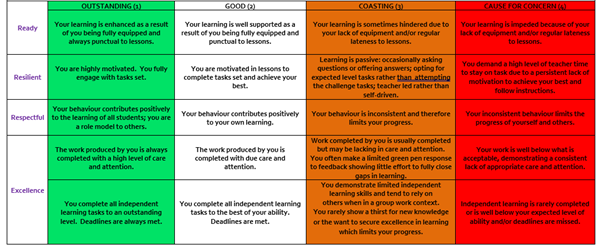
For students in Key Stage 4 a target and predicted grade will also be included in the report. The Target Grade indicates the grade we expect them to achieve at the end of Key Stage 4. It is generated using Key Stage 2 scores and comparing with the historic performance of students of a similar ability nationally at the end of Key Stage 4.
For GCSE subjects this will range from 9-1, while for Cambridge National subjects the grades will be L2D*, L2D, L2M, L2P, L1D, L1M or L1P, the table below shows the GCSE equivalent with these grades.
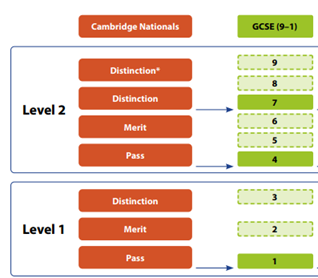
Finally, each report will include the cumlative attendance percentage for your child.
How Should Parents Use The Report?
- Identify your child’s strengths and areas of development in all subject areas.
- Support your child in addressing any areas of concern.
- Support your child in the preparation of future assessments, using the Key Knowledge Organisers which indicate revision topics.
- Be fully aware of what your child is studying by looking through the curriculum maps for each subject area on our website.
- Support your child in making sure all homework is completed to a good standard and is returned to teachers by the given deadline on Satchel One.
- Address any behavioural concerns with your child, supporting them in resolving any barriers to learning.
- Contact the subject teachers to discuss any concerns in more detail. This should be done by emailing admin@southaxholme-iet.co.uk and including FAO in the subject.