




Our Vision for Literacy
At South Axholme Academy, we believe that literacy is the foundation of success in every subject and every future pathway. Reading confidently enables students to access the full curriculum, think critically, communicate effectively and participate fully in society. We believe that every teacher is a teacher of literacy, and every lesson provides an opportunity to develop students' reading, vocabulary, writing and communication skills.
Our literacy strategy adopts a structured, evidence-informed, tiered approach that raises standards in reading, vocabulary and disciplinary literacy across Key Stages 3 and 4. We are committed to improving reading accuracy, fluency and comprehension for all students, closing literacy gaps for disadvantaged and SEND learners, and embedding high-quality literacy teaching across the curriculum so that every student can fully access their learning and achieve their potential.
Our whole-school strategy combines explicit vocabulary instruction, high-quality reading experiences, targeted intervention and consistent classroom practice to ensure literacy remains at the heart of everything we do.
A Tiered Approach to Literacy
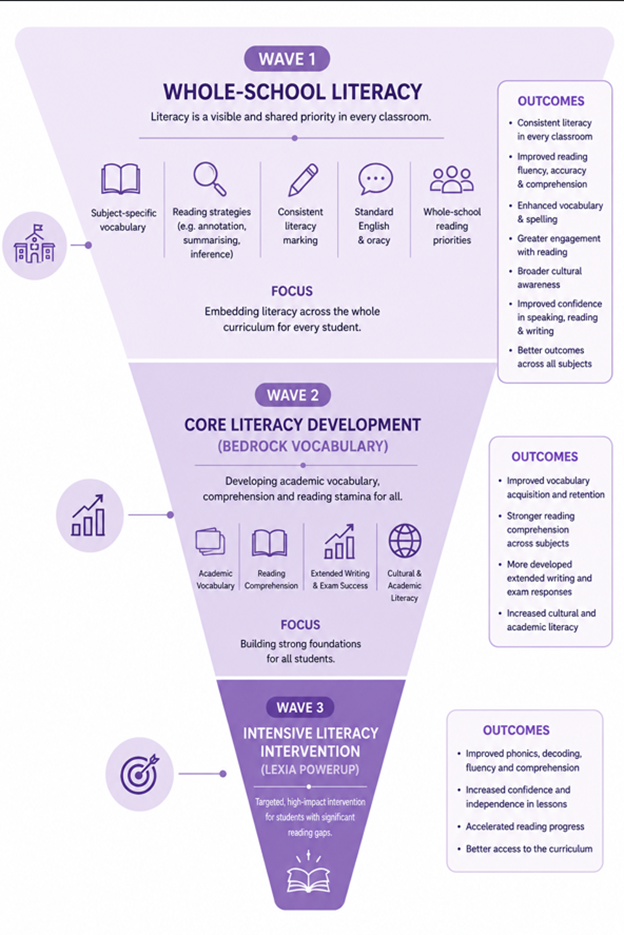
Our literacy strategy is delivered through three complementary waves of support:
- Wave 1: High-quality literacy teaching for every student in every classroom.
- Wave 2: Structured vocabulary and comprehension development through Bedrock Learning.
- Wave 3: Intensive, targeted intervention for students with significant literacy needs through Lexia PowerUp.
This graduated model ensures that every student receives the appropriate level of support whilst allowing interventions to be adapted as students make progress.
Assessment and Identification
Students' literacy needs are identified through a range of assessment information including:
- KS2 Reading SATs outcomes.
- Baseline reading assessments on entry to South Axholme Academy..
- Teacher assessment.
- Lexia diagnostic assessments.
- Bedrock Learning data.
- Ongoing classroom assessment and curriculum performance.
- Reading ages and literacy progress are reviewed regularly to ensure students receive the appropriate level of support and can move between intervention waves as their needs change.
Staff Development
High-quality literacy teaching depends upon high-quality professional development. All staff receive regular training in evidence-informed literacy practice, including disciplinary literacy, vocabulary instruction, reading strategies and effective classroom approaches that develop students' confidence in reading, writing and communication. This ensures a consistent approach to literacy across every subject and every classroom.
Wave 1: Whole-School Literacy
Purpose
To embed high-quality literacy teaching across every subject so that all students can successfully access, understand and communicate subject knowledge. Literacy is everyone's responsibility and is woven into everyday classroom practice throughout the Academy.
Delivery Model
Across every curriculum area, teachers:
- Explicitly teach subject-specific Tier 2 and Tier 3 vocabulary.
- Model and explain unfamiliar academic language.
- Teach reading strategies such as annotation, summarising, questioning and inference.
- Support students in developing disciplinary literacy within their subject.
- Apply a consistent whole-school literacy approach when providing feedback.
- Reinforce the accurate use of Standard English.
- Develop students' confidence through purposeful speaking and listening opportunities.
- Embed literacy within curriculum planning to ensure progressive development across all year groups.
Vocabulary Development
A rich vocabulary underpins success across the curriculum.Teachers explicitly teach, revisit and reinforce ambitious academic vocabulary, ensuring students understand both the meaning and application of new words within different subject contexts. Vocabulary instruction is carefully planned to enable students to retain and confidently use increasingly sophisticated language in both their spoken and written work.
Reading Across the Curriculum
Reading is fundamental to learning. Students are regularly exposed to challenging, high-quality texts across all curriculum areas, enabling them to develop reading fluency, comprehension, resilience and subject-specific knowledge.
Teachers model expert reading, explicitly teaching students how to:
- decode unfamiliar vocabulary
- annotate texts effectively
- identify key information
- make inferences
- summarise ideas
- evaluate evidence
- understand increasingly complex texts.
- These strategies enable students to become increasingly independent readers who can confidently access the demands of the secondary curriculum.
Register and Read (RnR)
Every week, students participate in Register and Read (RnR) during tutor time.
This structured reading programme exposes students to a carefully selected range of high-quality fiction and non-fiction texts spanning a variety of genres, historical periods, cultures and contemporary issues.
- Sessions are designed to develop:
- Reading fluency
- Reading accuracy
- Reading comprehension
- Vocabulary acquisition
- Spelling development
- Cultural knowledge
- Understanding of current affairs
- Reading confidence
- Reading enjoyment
- Through regular shared reading experiences, students broaden their understanding of the world whilst developing the literacy skills required for academic success.
Whole-Class Novel Reading
Every student studies at least one complete novel during tutor time each academic year. Teachers model fluent reading aloud, demonstrating expression, pace, intonation and comprehension strategies while encouraging students to track the text and engage actively throughout.
This programme develops:
- reading stamina
- reading fluency
- comprehension
- empathy
- cultural awareness
- reading for pleasure.
Current texts include:
- Year 7: A Monster Calls – Patrick Ness
- Year 8: Refugee Boy – Benjamin Zephaniah
- Year 9: The Things We Leave Behind – Claire Furniss
Writing Across the Curriculum
Writing is an essential component of disciplinary literacy. Students are explicitly taught how to communicate their knowledge effectively within different subject disciplines through opportunities for structured and extended writing.
Teachers support students by:
- modelling high-quality writing
- teaching subject-specific writing conventions
- developing sentence construction and paragraph organisation
- explicitly teaching academic language
- providing regular opportunities for extended writing
- giving purposeful feedback that develops both literacy and subject knowledge.
- This consistent approach enables students to write with increasing accuracy, confidence and sophistication across every curriculum area.
Oracy
Speaking and listening are central to literacy development. Across the Academy, students are taught to communicate confidently using ambitious vocabulary and subject-specific language.
Teachers provide structured opportunities for students to:
- explain their thinking clearly
- justify opinions using evidence
- participate in academic discussion
- present ideas confidently
- listen actively and respectfully
- build upon the ideas of others.
Developing strong oracy skills strengthens reading comprehension, supports high-quality writing and prepares students for further education, employment and life beyond school.
Bedrock Learning
All students complete regular Bedrock Learning assignments each week to reinforce vocabulary acquisition, morphology, comprehension and academic language. Bedrock provides structured opportunities for students to revisit previously taught vocabulary whilst introducing increasingly ambitious academic language that supports success across every subject. Progress is carefully monitored to ensure students remain engaged and continue to develop their literacy skills independently beyond the classroom.
Year 7 Library Programme
To encourage lifelong reading habits, every Year 7 student visits the local library once each term.
These visits are designed to:
- promote reading for pleasure
- develop independent book selection
- increase access to a wide range of high-quality texts
- encourage sustained reading habits
- build confidence in using community learning resources.
- We believe that fostering a love of reading is one of the most effective ways of improving educational outcomes and broadening students' horizons.
Expected Outcomes
Through our Wave 1 provision we expect students to develop:
- consistently strong literacy skills across every subject
- improved disciplinary literacy
- greater reading fluency, accuracy and comprehension
- enhanced vocabulary knowledge
- improved spelling and written communication
- greater confidence in speaking and listening
- increased reading stamina
- higher levels of engagement with reading
- broader cultural understanding
- improved academic outcomes across the curriculum.
Wave 2: Core Literacy Development (Bedrock Learning)
Purpose
Wave 2 provides structured literacy support for students who can read independently but require additional development in vocabulary, reading comprehension and academic language. The programme strengthens students' ability to access increasingly challenging curriculum content whilst improving confidence across all subjects.
Entry Criteria
Students may access Wave 2 provision where they:
- have reading ages within one to two years of their chronological age
- demonstrate secure decoding skills but require development of academic vocabulary
- are part of the universal KS3 programme
- are targeted within KS4 to support examination success
- are English as an Additional Language (EAL) learners requiring structured vocabulary development
- would benefit from additional support to improve reading comprehension and written communication.
Delivery Model
Wave 2 support is delivered through a combination of classroom teaching and independent learning.
Students access:
- regular Bedrock Learning assignments each week
- explicit vocabulary instruction across the curriculum
- opportunities to revisit and consolidate previously taught vocabulary
- English curriculum activities linked to academic language development
- structured reading comprehension activities
- independent practice designed to improve retention and application of new vocabulary.
Monitoring Progress
Student progress is monitored using:
- Bedrock Learning dashboards
- weekly completion rates
- vocabulary accuracy data
- teacher assessment
- curriculum outcomes
- literacy reviews led by the Literacy Lead.
This information is used to identify students requiring additional support or movement into more intensive intervention.
Expected Outcomes
Students participating in Wave 2 will develop:
- stronger academic vocabulary
- improved reading comprehension
- increased confidence when reading challenging texts
- greater understanding of subject-specific terminology
- improved extended writing
- enhanced communication skills
- greater success in classroom learning and examinations.
Wave 3: Intensive Literacy Intervention (Lexia PowerUp)
Purpose
Wave 3 provides highly targeted intervention for students with significant literacy needs.
The programme is designed to accelerate progress in reading accuracy, decoding, fluency and comprehension, enabling students to access classroom learning with increasing confidence and independence.
Entry Criteria
Students are prioritised where they:
- have reading ages significantly below their chronological age
- have reading ages more than three years below expected
- are in Key Stage 3 with reading ages below approximately 9–10 years
- are in Key Stage 4 with reading ages below approximately 10–11 years
- have SEND needs affecting decoding, fluency or comprehension
- are unable to fully access Bedrock Learning independently
- are identified through KS2 Reading SATs, baseline assessments, teacher assessment or literacy screening.
Delivery Model
Students receive:
- one or two timetabled intervention sessions each week
- small group or one-to-one teaching
- structured Lexia PowerUp lessons delivered by trained Teaching Assistants
- additional targeted support where appropriate
- carefully planned withdrawal sessions that minimise disruption to the wider curriculum.
The programme develops:
- phonological awareness
- decoding
- word recognition
- vocabulary
- grammar
- comprehension
- reading fluency.
Monitoring Progress
Progress is monitored through:
- myLexia diagnostic reports
- lesson observations
- reading age assessments
- teacher feedback
- intervention reviews
- ongoing evaluation by the SEND and Literacy teams.
Interventions are reviewed regularly to ensure students continue to receive the most appropriate level of support.
Expected Outcomes
Students participating in Wave 3 will demonstrate:
- accelerated improvements in reading age
- improved decoding skills
- greater reading fluency
- stronger comprehension
- increased confidence when reading independently
- improved access to the wider curriculum
- greater independence in lessons
- improved long-term educational outcomes.
Measuring the Impact of our Literacy Strategy
The success of our literacy strategy is evaluated through a range of quantitative and qualitative measures.
These include:
- improvements in reading ages
- Lexia PowerUp progress data
- Bedrock Learning completion and vocabulary growth
- improvements in reading fluency and comprehension
- quality assurance of classroom literacy practice
- work scrutiny
- student voice
- attendance at intervention sessions
- curriculum assessment outcomes
- external examination performance
- narrowing literacy gaps for disadvantaged and SEND students
- increased engagement with reading for pleasure.
The impact of the strategy is reviewed regularly to ensure that it continues to meet the needs of our students and reflects the latest educational research and best practice.
Monitoring and Evaluation
The implementation of the literacy strategy is overseen by senior leaders, the Literacy Lead and Subject Leaders.
Monitoring includes:
- lesson visits
- learning walks
- book scrutiny
- student voice
- curriculum reviews
- intervention monitoring
- analysis of literacy data
- departmental self-evaluation.
Departments are expected to embed literacy consistently within their curriculum planning, whilst leaders provide support and professional development to ensure high-quality implementation across the Academy.
Working in Partnership with Parents and Carers
Parents and carers play a vital role in developing confident readers.
We encourage families to support literacy development by:
- reading regularly with their child
- encouraging independent reading for pleasure
- discussing books and current affairs at home
- supporting the completion of Bedrock Learning assignments
- celebrating reading achievements
- making use of local library services.
By working together, we can help every young person develop the literacy skills, confidence and knowledge needed to flourish both within school and beyond.
Our Commitment
At South Axholme Academy, literacy is at the heart of learning. Every student deserves the opportunity to become a confident reader, articulate communicator and successful learner, regardless of their starting point.
Through high-quality teaching, targeted intervention and a shared commitment from staff, students and families, we strive to ensure that every young person leaves South Axholme Academy equipped with the literacy skills they need to achieve their ambitions, access future opportunities and make a positive contribution to society.