








Our Approach to Teaching and Learning
At South Axholme Academy, every lesson is carefully designed around what educational research tells us about how students learn best. Rather than adopting individual teaching strategies in isolation, we have developed a consistent instructional approach that is underpinned by Rosenshine's Principles of Instruction, cognitive science and the guidance published by the Education Endowment Foundation (EEF).
Our approach is based on a simple principle: the highest quality teaching, delivered consistently in every classroom, has the greatest impact on improving student outcomes. This is known as Quality First Teaching and is the cornerstone of our curriculum implementation and school improvement strategy.
Quality First Teaching ensures that all students, regardless of background, starting point or additional need, receive excellent classroom instruction every day. By explicitly teaching new knowledge, checking understanding frequently, providing guided practice, giving timely feedback and gradually developing students' independence, we reduce barriers to learning and enable every student to achieve success.
Everything you will see in a South Axholme lesson, from retrieval practice and carefully sequenced explanations to mini whiteboards, live feedback and independent practice, has a clear evidence base. These routines are not simply classroom habits. They are deliberate strategies that improve long term memory, strengthen understanding and support students in becoming confident, resilient and independent learners.
This consistent approach means that students know what to expect in every classroom, allowing them to focus on learning rather than routines. It also enables our staff to continually refine their practice through professional development, instructional coaching and collaboration, ensuring that the quality of teaching continues to improve year on year.
Our sustained academic success is built upon this unwavering commitment to evidence informed practice. By placing Quality First Teaching at the heart of everything we do, we create classrooms where all students are supported, challenged and inspired to Expect Excellence.
SAX Common Language
At South Axholme Academy, consistency is fundamental to creating calm, purposeful and highly effective classrooms. We use a shared language across the Academy so that students experience the same clear expectations in every lesson, regardless of the subject or teacher. This consistency reduces cognitive load, minimises uncertainty and allows students to focus their attention on learning.
Our common language supports high-quality teaching by establishing predictable routines, promoting positive learning behaviours and enabling teachers to give clear, concise instructions. Over time, these routines become habits, helping students to develop independence, resilience and confidence in the classroom.
The phrases below are used consistently by all staff and are understood by all students. They form part of our commitment to Quality First Teaching and ensure that every classroom provides a calm, respectful and productive learning environment where every student can Expect Excellence.
|
What we say |
What we expect |
|
Empty hands, eyes on me / the board |
Students are to have nothing in their hands, for example they put their pen down, and look at the teacher or the board, depending on the instruction given. At this point, the teacher will be explaining new learning or giving an important instruction, so it is essential that they have every student's full attention. |
|
Guesses, not gaps |
This is our mantra across South Axholme Academy. We expect every student to have a go, even if they are unsure of the answer. Staff use this phrase regularly during Do It Now activities and mini whiteboard tasks to encourage participation and resilience – a core SAX value. If a student genuinely does not know the answer, a question mark shows the teacher that they have engaged with the task but require further support. |
|
3, 2, 1... |
This is our whole school signal for attention. By the time the teacher reaches "1", all students should be silent, focused and ready to listen to the next instruction. |
What does a lesson look like at SAX?
Starts of lessons:

Lessons begin with a ‘Do It Now’ task that is based on retrieval practice. This is normally 3-5 questions that students will answer independently. This is a short, timed activity. Students will then use their green pen to ‘tick and fix’ their answers.
The rationale:
We start lessons using retrieval practice as research shows there are many benefits to this, including:
- Identifying gaps in knowledge
- Checks for misunderstandings and allows misconceptions to be addressed instantly
- Making and strengthening connections
- Makes connections robust under pressure
- Makes it easier to learn new things
The main part of the lesson:
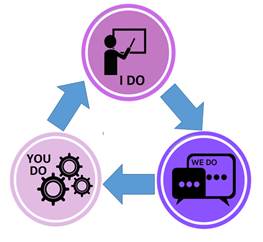
At SAX, we use a teaching approach based on educational research by Rosenshine called gradual release of responsibility. In lessons we refer to this as “I do, We do, You do.” This approach helps students build confidence and develop independence by learning new knowledge and skills in manageable steps.
I do: in this part of the lesson the teacher introduces and explains new learning in small chunks. They demonstrate a new skill, concept or process. They explain their thinking clearly and show students what successful work looks like. This gives students a clear example to learn from.
We do: in this part of the lesson the teacher and students work together. Students can practise the new learning with support, ask questions and receive immediate feedback. Misconceptions are addressed instantly and understanding is strengthened. This stage helps to secure understanding prior to students working independently.
You do: in this part of the lesson students apply their learning independently. By this stage, they have seen the skill demonstrated and have practised it with support, enabling them to complete tasks with increasing confidence and success.
The rationale:
Research shows that students learn best when new learning is introduced gradually and supported carefully. The “I, We, You” approach helps students to:
- understand new ideas and concepts more clearly
- build confidence through guided practice before working independently
- develop independence in their learning, developing knowledge and skills over time
- receive timely support and feedback
- remember and apply knowledge more effectively
- Become resilient and independent learners
By moving carefully from teacher guidance to independent practice, we ensure that students are supported at every stage of their learning journey while being challenged to achieve their full potential.